TELL US YOUR STORIES
Share Your Recollections About the Ford Foundation HERE
MEMBER FORUMS
Affinity Groups (2) |
Events (5) |
Volunteers (2) |
Classifieds () |
Recollections (1) |
 |
SPOTLIGHT
|
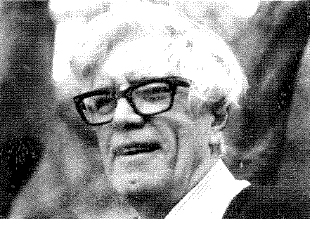
Frank Sutton (1917-2012): One of a Kind
His impact was apparent in the scores of tributes to his life and work following his death in December at the age of 95.
“Frank was a pivotal figure in the Foundation’s development program,” wrote Shep Forman, president of LAFF, in a message to the members. “He was also a stalwart member of the LAFF Society where many of us had the good fortune to continue to enjoy his formidable intelligence, his knowledge and appreciation of culture and the arts, his wit and humor, and his marvelous recall of the Foundation’s work in so many areas of interest to us all.”
“He really was one of a kind,” wrote Richard Magat, who had been director of the Office of Reports, “not only for his knowledge and scholarship but for his genial friendship, not just for higher-ups but for the lower orders like myself.”
Charles Bailey, who worked in several Foundation offices overseas, remembered him as “always so generous, insightful, funny and kind. The news that he is no longer with us saddens me. The world needs more people like Frank.”
Robert Tolles, an editor of the LAFF newsletter, said, “He occupied a special place in my thoughts. I could always call him if I had a question about the early Foundation years or to ask him to write a tribute to a departed colleague.
Of all the Foundation staff, he represented the best of its traditions and loyalties.”
“He was a joy,” wrote Alice Maloney, who had worked for Frank in the International Division, “and I feel very fortunate to have known this truly remarkable man.”
Frank joined the Foundation in 1954 from Harvard University, where he lectured on social relations and was an assistant professor of sociology and general education. He started at Ford as an executive associate in the Behavioral Sciences Program. Three years later he became program associate for the Overseas Development Program’s Near East and Africa division and three years after that went to Nairobi, Kenya, as the Foundation’s representative for East Africa.
His account of his years in Nairobi, including setting up the first office, appears on the LAFF website. It is part of a personal memoir he was writing, and was excerpted in the last issue of the newsletter.
In 1967, a year after the International Division was created, he returned to New York to be assistant to the vice president of the new division, then serving as Deputy Vice President into the early 1980s. During that time he also served as Officer in Charge of the European and International Program, until he retired in 1983.
Frank was born on July 7, 1917, in Oneida, P.A., and received a bachelor’s degree in mathematics from Temple University in 1938. He then taught math while earning a master’s degree from Princeton University in 1940, moving on to Harvard University for a second master’s, this time in sociology.
He went into the Air Force in 1941 and served as an aerial navigator, reaching the rank of captain before leaving the service in 1945.
He went back to Harvard and earned his doctorate in sociology in 1950, being selected a Junior Fellow of the university’s Society of Fellows while he earned the degree. He taught at Harvard until 1954, when he left to go to work for the Foundation.
Frank did not slow down after he retired. He was a consultant to Ford for several years, writing a history of the Foundation’s international work. He also was a consultant to several other organizations, including the Rockefeller Foundation, for which he was interim director of its conference center in Bellagio, Italy, in 1992, and the World Bank. He worked closely with the Social Science Research Council (SSRC), as its acting president in 1985-86 and chairman of its board from 1985 to 1992.
He wrote prolifically, principally the books The American Business Creed in 1956 and Ideology and Social Structure in 1991. He was also editor of A World to Make: Development in Perspective, published in 1990.
Frank’s interests and skills were varied. When in college he earned some extra money by playing first base for the Trenton, N.J., Potters in an industrial league. And he never lost his love for the Philadelphia Athletics or his favorite player when he was growing up not far from Shibe Park, Al Simmons.
Early music lessons paid off too. He earned some more extra money in the 1930s by playing clarinet and saxophone in dance bands in and around Bucks County. And he played classical piano throughout his life, including in Nairobi where he organized a chamber music group.
“I have never in a lifetime of amateur chamber music playing had better companions,” he wrote in his memoir. “There were a fine Goan and the Belgian consul on violins, a young violist from the Oxford press, and the physics professor from the university on cello, all to go with the grand piano in the house on Riverside Drive.”
Historian Manqué
by Richard Magat
Had the Ford Foundation ever had an official historian, Frank Sutton would have been the odds-on favorite.
Although he wrote innumerable articles he published only two books: The American Business Creed in 1956 and Ideology and Social Structure in 1991, neither of which dealt with the Foundation. But for more than three decades he compiled a history of the Foundation’s international and other activities, none of which has been published. The cache wound up in 321.8 cubic feet of records and 79 legal-size boxes that repose in the Rockefeller Archive Center in Tarrytown, N.Y., to which the Ford archives were consigned last year. One of the most valuable elements is an oral history of 73 interviews with staff members and trustees. Fortunately, one of them is Frank Sutton’s.
Sutton’s most extensive insights about philanthropy generally and Ford in particular are contained in two disparate works published in 1987. One, The Ford Foundation: The Early Years, is a 50-page essay by Sutton in the Winter issue of Daedalus. He likens the Foundation to one of many great public figures: “Their origins and youth attract curiosity that can be gratified in coherent and smooth-textured narration. Later they become like great trees with proliferating branches and foliage that blinds the sight. So it has been with the Ford Foundation. Its beginnings have been told several times, and some of the branches followed, but the canopy remains largely undescribed.”
Ironically, the “canopy” had undergone a description of sorts 32 years earlier in a series of articles in The New Yorker by Dwight Macdonald. The articles were converted into a book whose subtitle was The Men and the Million—An Unauthorized Biography. Forty-one years later, a new edition was published. Enter Frank Sutton, who was commissioned to write an introduction. The resulting essay combined Sutton’s erudition and a fine sense of humor reflecting Macdonald’s own literary gifts.
The book did not delve as deeply as the Daedalus article into the origins of the industrial behemoth that gave rise to the Foundation, but it did describe the tremors that shook the Foundation when Macdonald announced his intention to dissect it. It was the height of McCarthyism, and conservative journalists, Macdonald wrote, “were tirelessly alerting their audience to the dubious actions and purposes of the Foundation….Two Congressional investigations…were highly colored by suspicions that foundations were leading the country toward socialism or otherwise undermining its character.”
Both the Daedalus essay and Sutton’s introduction to the Macdonald book remarked about the paucity of serious writing about the Foundation, notwithstanding that histories had been written about some of its offshoots, e.g., the Fund for the Republic and the Fund for Adult Education. “Institutional history is certainly not one of the ingratiating literary genres, but even the big banks now seem to find willing chroniclers,” Sutton noted.
A Defining Influence
by Arthur I. Cyr
Frank Sutton remains a defining influence for me as well as a wonderful role model. About forty years ago I had the opportunity to spend three years on the staff of the Ford Foundation. I am indebted to Craufurd Goodwin, the officer in charge of European and International Affairs, as well as Andrzej Korbonski and Howard Swearer, two University of California at Los Angeles mentors.
Frank Sutton, however, made the final hiring decision. The interview with him remains remarkably vivid in memory. His unusual combination of intellectual depth, executive ability and intuitive insight were striking. He also was skillful at putting a very young job candidate at ease without compromising professionalism.
Over the years we remained in regular contact. He recommended me to John Rielly, president of the Chicago Council on Foreign Relations, for a job that was challenging and risky but ultimately more rewarding than a conventional academic path. Frank indicated as much when we discussed the opportunity.
My youngest son, Jay, and I took several trips to the East Coast. Among our many shared memories, lunch at the Century Association with Frank Sutton is a special highlight. After Jay died, the letter from Frank was particularly helpful.
‘A Lovely Man’
by Robert Edwards
What a lovely man, the quality of whose love and kindness to those who knew him well was, if anything, even greater than his distinguished mind. What a range of understanding he had—and how fortunate the Ford Foundation was to have his humanity as well as learning and brilliance (a word I’ve applied to only three or four people I’ve known) to explain Africa to it.
He was my mentor for a decade at Ford in a way that influenced deeply my two college presidencies. Blythe and I came to love him greatly in these last years of his “retirement”. We’re still downcast, but he will continue to light our sky for the rest of our lives—as he will the organizations he helped to form.
With Wisdom and Patience
by David Featherman
He was, in so many ways, a man of extraordinary capacity and dimensions and thus his going leaves so many and such large empty places in so many hearts and minds.
Frank served on the board of the Social Science Research Council (SSRC) when I was chosen to be its President, in 1989. It was not the best of times for the Council, especially in its longstanding relationship with the Ford Foundation. In his wisdom, and with respectful patience for a young professional taking on much more than he knew how to handle, Frank walked me through the repairing process that only someone of his acumen and institutional savvy would do and could know how.
He also was my staunchest supporter and ally as I sought to redefine the leadership role of SSRC vis-à-vis what then was still called foreign area studies, and to align the Council at the forefront of comparative social science.
I know I would have been considered a much lesser steward of the Council were it not for the gifts Frank shared with me, what he taught me.”
|