TELL US YOUR STORIES
Share Your Recollections About the Ford Foundation HERE
MEMBER FORUMS
Affinity Groups (2) |
Events (5) |
Volunteers (2) |
Classifieds () |
Recollections (1) |
 |
NEWSLETTER
|
Fords Role in Grappling with Poverty By Alan Divack
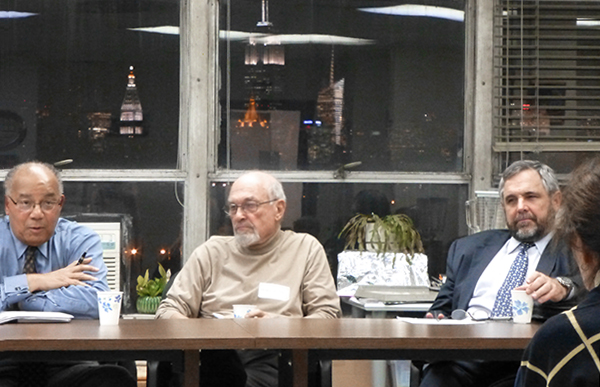
LAFF Society members gathered at a rather unusual venue last fall for a review of the Ford Foundation’s attempts to grapple with poverty in the United States over the decades.
The place was the fourth floor of the Emigrant Savings Bank Building at the corner of East Broadway and Grand Street on New York City’s Lower East Side, home to the Educational Alliance’s Naturally Occurring Retirement Community (NORC) facility. The day was November 19.
Being on the lower east side gave several LAFFers the opportunity to take an informal walking tour of the neighborhood for two hours before the meeting, observing how ethnic succession was a constant in the area and getting a personal introduction to the subject they would hear discussed.
The Educational Alliance is a pioneering settlement house founded in 1889 to serve the needs of new immigrants, largely from eastern Europe, and which continues to serve immigrant populations today. Members had suggested that LAFF look for meeting places closer to the locus of foundation programs and we were able to use the EA facility through the efforts of Jennifer Powell, formerly of Ford’s Economic Development program and now EA’s vice president for development. Although Ford has partnered with other grantees in its programs in the neighborhood, it was refreshing to meet where work of the kind the Foundation has long supported was taking place.
The excellent acoustics facilitated the lively discussion at the meeting, where two former and one current Foundation staff members gave presentations: Henry Saltzman, who served in the late 1950s and early 1960s in the Public Affairs program; Robert Curvin, who was director of the Urban Poverty program in the late 1980s and early 1990s and then was Vice President for Communications, and George (Mac) McCarthy, current director of Ford’s Metropolitan Opportunity program. In part because of the strengths and experience of the speakers, the meeting focused on community development broadly defined, and dealt just briefly with such areas as workforce development, work supports and financial services for the poor.
After welcomes by Michael Seltzer, chair of the LAFF Society program committee, and myself, chair and organizer of the event, Saltzman discussed the origins of the Foundation’s Gray Area programs of the late 1950s and early 1960s, which dealt with the problem of new migrants to urban areas, largely African-Americans from the rural south and, to a lesser extent, Puerto Ricans, and which grew out of the early Great Cities programs, which had worked on problems of large urban school districts. The program’s focus on in-migration, Saltzman said, was in part a way to address the needs of disadvantaged racial and ethnic minorities without tackling the issue of race head on.
Paul Ylvisaker, director of the Public Affairs program at the time and the key figure in the beginning efforts to address issues of poverty and race, conceived of the Gray Areas programs as a way of dealing with the needs of the poor in a more holistic way. Although schools remained central to the effort, the Foundation worked with partners, generally a public benefit corporation tied to the local government, to provide a wide range of services and involve the population in decision making.
After the Gray Areas programs, the Foundation began to address the needs of poor communities largely through community development corporations. The first CDCs were founded in the late 1960s with Ford involvement, led by the Bedford Stuyvesant Restoration Corporation. Although Curvin did not join the Foundation until the late 1980s, at which point he had oversight for CDC programs, he had been involved with CDCs as a community activist in Newark, N.J., in the late 1960s.
CDCs were non-profits that brought together community leaders with representatives of foundations, government and the private sector to mobilize resources for the communities. Curvin discussed one of the more powerful critiques of the CDCs, which is that essentially they became housing development organizations and did not deal adequately with other needs of the poor. This position was advanced most forcefully by Nicholas Lemann in an article in The New York Times Magazine in 1994, where he argued that the needs of poor people would have been met better by enabling them to move to communities where they had access to jobs, education and services rather than by attempting to develop better housing that would keep them in the communities where they lived.
Curvin said that after several decades of reflection he had come to see the value in Lemann’s critique and spoke with passion of programs designed to increase the incomes of the poor, in particular the Earned Income Tax Credit.
George McCarthy explained how, when the Foundation reorganized its programs in 2009, it attempted to take a system approach to urban problems, to see what had and had not worked and where, given the limited philanthropic resources, it could intervene with the most impact. The focus of the program now is on how to support efforts that reach beyond individual neighborhoods and cities to connect residents with opportunities in their broader metropolitan economies. Ford supports organizations that pursue integrated approaches to housing; land use and environmental planning; public transportation and community infrastructure, and aligned workforce opportunities.
One issue raised in the lively discussion that followed was the role of education in antipoverty programs. Questions also were raised whether Ford and other foundation programs have adequately addressed the problem of growing economic inequality in recent decades and whether the use of the proxy power of endowments to limit executive compensation would be a useful strategy to address this.
|