TELL US YOUR STORIES
Share Your Recollections About the Ford Foundation HERE
MEMBER FORUMS
Affinity Groups (2) |
Events (5) |
Volunteers (2) |
Classifieds () |
Recollections (1) |
 |
NEWSLETTER
|
Latin America and the Arab Spring: Civil-Military Relations By Shepard Forman
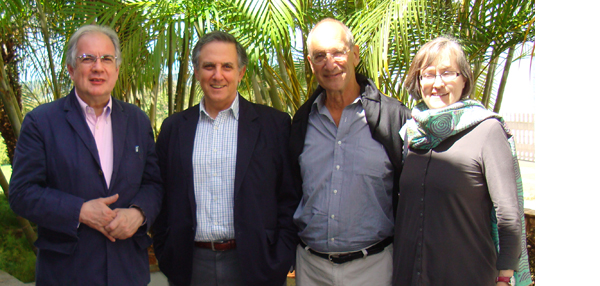
Reuniting at a workshop in Brasilia on lessons applicable to the Middle East of democratic transitions in Latin America were these former Ford Foundation staffers. The workshop brought together 25 scholars and practitioners from 12 countries, organized on behalf of the Norwegian Foreign Ministry by the Norwegian Peace- Building Resource Center, and was directed by Mariano Aguirre (at left), former program officer for Peace and Security. The others: (left to right) Augusto Vargas, former Ford representative in Chile, Shep Forman, LAFF president, and Judy Barsalou, former Ford representative in Cairo.
Four former Foundation staff members were reunited recently in Brasilia at a workshop, “Agents or Guardians: Military-Civilian Relations in Latin America and the Middle East,” jointly designed by the Christian Michelsen Institute in Bergen, Norway, and the University of Brasilia’s International Relations Department. The workshop, organized on behalf of the Norwegian Foreign Ministry by the Norwegian Peacebuilding Resource Centre (NOREF), directed by Mariano Aguirre (former Program Officer for Peace and Security), brought together twenty-five scholars and practitioners from Argentina, Brazil, Chile, Colombia, Egypt, Italy, Jordan, Norway, Portugal, Syria, the United States and Uruguay to see what lessons might be learned from the thirty year old democratic transitions in Latin America that might be applicable to the transitions now underway in the Middle East.
Augusto Varas, former Ford Representative in Santiago, Chile, keynoted the meeting with a fascinating analysis of the processes of military professionalization in democratizing contexts, emphasizing matters of institutional culture, role definition and, critically, civilian control. The four panels that followed extended Augusto’s presentation to consider in greater detail the goals and obstacles in the way of political and security reform. With reference to the latter, LAFF President Shep Forman raised questions about the global and regional political-economy contexts for reform, the roles of NGOs and civil society more generally, and the problematic fact of the privatization of military and security services. A third panel on civil society and the armed forces explored these themes in greater depth.
In the fourth and final panel, Judy Barsalou, former Ford Representative in Cairo, gave a stunning presentation of the research she is currently undertaking at American University in Cairo on transitional justice in its historical, cultural, political and legal dimensions. She highlighted the difficulties inherent in the choices between amnesty, truth commissions and trials, taking note of the perceived pros and cons of each modality. She then described the results of survey research and in-depth interviews that she is conducting among Egyptians in order to understand how they perceive the processes of transitional justice, including their perception of the current trial of deposed Egyptian President Hosni Mubarek and their preferences for future action.
While the workshop was far from conclusive, it did raise important questions regarding the quest for democratic consolidation in Latin America and the pathways, pitted as they are, to democratization in the Middle East. Participants raised questions about the applied utility of social science research in this area and its relationship to public policy and political action; about the practicality of comparative research across regions marked by their own heightened internal divergences; and about the need to extend our knowledge of transitions in historical time and across a larger number of cases, some of which, like Indonesia, might have particular relevance for at least some Middle Eastern states. There was broad-based consensus that this should not be a one-off workshop but the start of a series of shared research projects and dialogues that both pushes the frontiers of our knowledge on democratic transitions and derives applicable lessons for those struggling to move them forward on the ground.
Toward that end, the value of bringing together scholars from diverse disciplines and multinational and multi-cultural settings was evident throughout the two and one-half days of meetings and celebrated, of course, over Brazilian churrascos and caipirinhas and tours of Brazilian architect Oscar Niemeyer’s modernist capital.
|