TELL US YOUR STORIES
Share Your Recollections About the Ford Foundation HERE
MEMBER FORUMS
Affinity Groups (2) |
Events (5) |
Volunteers (2) |
Classifieds () |
Recollections (1) |
 |
NEWSLETTER
|
New York Meeting
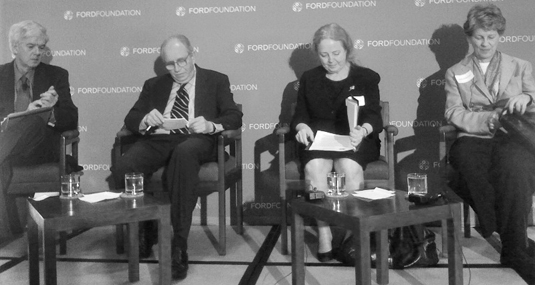
James A. Smith, chair, at left, with Peter Hakim, Irena Grudzinka Gross, and Gail Gerhart during the panel discussion at the Ford Foundation. Photo by Alan Divack.
More than 60 LAFF members participated in a lively LAFF discussion at the Ford Foundation on November 7 about the role played by the Foundation in supporting the transition to democratic governance in three key regions of the world.
The focus was on Latin America’s transition from military to civilian rule, the end of apartheid in South Africa, and the shift in Eastern Europe from communism to democracy. The three principal speakers were:
Peter Hakim, president emeritus and senior fellow of the Inter-American Dialogue, and past Ford assistant representative in Santiago, Chile and program officer in Rio de Janeiro, Brazil; Gail Gerhart, professor of political science at Columbia University and co-author of a six-volume history of the South African liberation struggle. Gail had been married to the late John Gerhart during his 29 years with the Foundation; and Irena Grudzinka Gross, associate research scholar in the Slavic Department at Princeton and Ford program officer in Central Europe in the mid-1990s.
These presentations stimulated an insightful exchange of views and memories from persons in the audience. There was general agreement that while the situations in the three subject regions had all involved challenges to the Foundation, it was difficult to draw generalizations covering all of them.
The situations in the three regions were sharply varied economically and politically, each eliciting a different Foundation response.
In Latin-America, for example, a key issue for the Foundation was whether to close the office in Santiago after the military overthrow of the Allende government in 1973. On the one hand, the Foundation was in a position to help independent persons or institutions who wanted to keep working or to leave the country. On the other, the Foundation wanted to disassociate itself from the military junta. After an internal debate in New York, the Foundation decided to continue working with persons and institutions in Chile but from offices in other Latin American countries.
In South Africa, the anticipated shift from apartheid to democratic rule in 1990 required the Foundation to shift its funding strategy. In the 1950s and 1960s, Ford concentrated on research programs that shed light on the economic and social conditions of the black population—for example, the South African Institute of Race Relations which published an annual survey of those conditions. With the anticipated ending of apartheid rule, Ford turned to other ways to prepare the population for eventual change—for example, support for public-interest law firms working on the legal problems of the non-whites and the expansion of educational opportunities for them.
In Eastern Europe, there was a similar shift in funding strategy with the dissolution of the Soviet bloc. In the 1950s, for example, the Foundation supported exchanges to expand contacts between educational and cultural leaders in the Soviet Union and those in Western countries. In the 1990s, grant-making focused on the development in Eastern Europe of human rights institutions and the development of a civil society.
The chair of the program was James A. Smith, vice president and director of research and education at the Rockefeller Center Archives Center at Pocantico in Westchester County north of New York City. Smith took advantage of the occasion to report on the shift, now underway, of the Foundation’s archives from the basement of the Ford Foundation building in New York to the Pocantico Center.
The Center was established in 1974, Smith said, as a repository for the records of the Rockefeller family and their various philanthropic efforts, including the Rockefeller Foundation, Rockefeller Brothers Fund and Rockefeller University. It is now being expanded into a records and research center for the study of philanthropy more generally.
With 11,000 reels of microfilm, its holdings already include materials from many non-Rockefeller foundations and nonprofit organizations making it a leading center for research on philanthropy and civil society.
It is also a major repository for the personal papers of philanthropic leaders, Nobel Prize laureates and scientific and medical researchers, and it conducts an active program of publications, workshops and symposia on philanthropy.
He invited the LAFF Society to schedule a membership meeting at the Center to familiarize its members with these unique resources.
The meeting ended with Foundation President Luis Ubiñas welcoming the LAFFers to the building, citing in particular guest Mary Bundy, and giving a brief report on Ford’s current grant-making programs. Notwithstanding the decline in its assets, he said, the Foundation this year has a grant-making budget of $465 million, the largest in its history. This is made possible by sharp cuts in its management costs.
|