TELL US YOUR STORIES
Share Your Recollections About the Ford Foundation HERE
MEMBER FORUMS
Affinity Groups (2) |
Events (5) |
Volunteers (2) |
Classifieds () |
Recollections (1) |
 |
NEWSLETTER
|
Breaking the Barrier of Fear By Ann Lesch
On January 25 I happened to be at a conference held near Tahrir Square when, in mid-afternoon, I watched in amazement as thousands of people streamed across the venerable Qasr al-Nil bridge into the square, the symbolic heart of Cairo.
People entered the square from all directions, in small clusters and large groups, chanting and carrying placards. Some 90,000 people had responded to the Facebook request to demonstrate on that public holiday and it felt like all of them had actually headed to the square. This astonished the young organizers, whose previous attempts to demonstrate had fizzled when perhaps a hundred people would show up out of thousands who emailed that they would come.
This time the young organizers went into the streets to appeal directly for support. For example, 7,000 men and women from the severely deprived neighborhood of Boulaq al-Dakrour joined the young activists and marched first to middle-class Mohandesseen and then on to Tahrir. (That was the orderly group I saw streaming across the bridge, merging with others from Cairo University.)
Once in the square they greatly outnumbered the heavily armed riot police. Although trucks with powerful water cannons charged into the crowds and police fired tear gas and rubber bullets as well as threw rocks, the demonstrators held their ground and pushed back, seeking to open the way to the parliament, the council of ministers and the hated Ministry of Interior. That night stalwarts held onto the square in the face of a violent onslaught. A protest seeking limited reforms had swiftly transformed into a revolutionary uprising that spread throughout Egypt.
Anger at President Hosni Mubarak’s rule had built over the past decade. An accidental president, who came to power only because of Anwar Sadat’s assassination in 1981, Mubarak initially calmed the public, emphasized the rule of law and managed relations with Israel in ways that preserved Egypt’s interests. However, as soon as he began his second term in 1987 he refused to reform the constitution, extended the state of emergency, promulgated laws to exclude the opposition from representation at the municipal level and ensured that the ruling National Democratic Party (NDP) won nearly all the seats in parliament.
When violence by Islamist fringe groups destabilized Egypt from 1992 to 1997, Mubarak unleashed the security forces, who arrested and tortured people at will, for reasons entirely unrelated to “terrorism”. Meanwhile, Mubarak’s sons Alaa and Gamal entered corrupt business deals with their business cronies, helping themselves to public assets while neglecting the economic and social infrastructure. The rich/poor gap increased vastly, with job-loss among bluecollar workers particularly severe. By 2010, 40 per cent of the population subsisted on $2 or less a day.
Given that the state of emergency forbade gatherings of more than five people and that the security forces had the power not only to attack people physically but also to expel them from their jobs or from school, there was tremendous fear. Nonetheless, there were many efforts to expose the conditions and to protest.
Novels and films highlighted corruption, police brutality, slum conditions and sexual harassment. Art exhibits (notably the Cairo Biennale in early January) displayed in-yourface paintings depicting torture and military repression, sometimes “disguised” as paintings related to South America, not the Middle East. Young people struggled to form NGOs and develop human rights groups despite crippling restrictions.
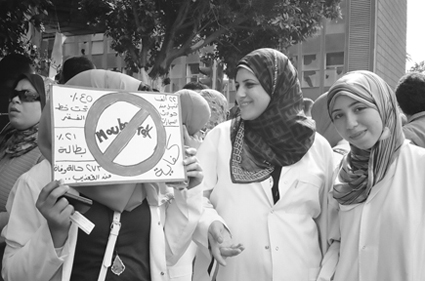
A range of political-action groups emerged: the March 9 movement for the independence of the universities (founded in early 2004), the Egyptian Movement for Change (Kefaya/Enough in late 2004), the April 6 Youth Movement formed in 2008 to support strikes by textile workers in El Mahalla El Kubra, and the first independent labor unions, established in 2009. Workers held lengthy sit-ins outside the parliament as well as protests at their worksites, while lawyers, journalists, doctors and judges demonstrated sporadically against the mounting restrictions on election processes and deteriorating work conditions. But demonstrations attracted few people and were easily contained by the burly security forces.
The cyber-world that emerged over the last decade was crucial in transforming the mode and content of communication and thereby heightening public awareness of, and anger at, the extent to which state repression and corruption were undermining Egypt. The growing concern about, and direct experience of, police brutality on the part of young people and their willingness to take the risk of speaking out were crucial in preparing the ground for the January 25 Revolution.
The very public beating to death last June of 28-year-old Khaled Said, seized from an internet cafe in Alexandria, outraged the public. Internet-organized protests were held in towns and cities during June and July. Large crowds of all ages confronted security forces on the streets of Alexandria and Cairo. “We’re all Khaled Said” became a rallying cry, chanted in fear as well as in determination.
Last fall people were pushed to the brink by the renewed crackdown on the media; accelerated repression of freedom of expression at universities and defiance of the court ruling to bar police inside the universities; outrageous rigging of the parliamentary elections; an ever-lengthening list of corrupt actions on the part of Gamal Mubarak together with members of the cabinet and parliament and their business partners; and fear that the 82-year-old Mubarak might run for election again in the fall of this year or, even worse, hand power over to his hated son. Nonetheless, I think the protesters themselves would agree that it took the swift removal of President Ben Ali in Tunisia to make them think that, if sudden change was possible in that country, it might be possible in Egypt.
Even when people broke the barrier of fear on January 25 and withstood the onslaught all day and night on January 28, they faced a formidable regime, supported by the security forces, the armed forces and the entrenched NDP. The revolution would have been much more bloody if the armed forces had stood by Mubarak. He and Interior Minister Habib al-Adly hastened their own demise by unleashing extreme violence on January 28, followed by Adly’s withdrawal of police forces that night in an effort to create chaos. That enraged the public and led them to create neighborhood watches to ensure the safety of their communities.
Mubarak further miscalculated that he could offer “carrots” (e.g., the appointment of a vice president and new prime minister and promises not to run for another term and to slightly amend the constitution) in his speeches on January 28 and February 1–the latter coming at the end of a day in which an astounding eight million people marched peacefully throughout Egypt, calling for the entire regime to leave–but simultaneously order fierce attacks by NDP goons, snipers and even horse- and camelback riders the next day.
As protesters held their ground in Tahrir Square, labor strikes loomed, thousands of people flooded to Cairo from the provinces to call for dignity and freedom, public institutions were shaken by protests from their employees, and professional syndicate members marched in orderly ranks within the square, the Supreme Council of the Armed Forces ended its proclaimed neutrality and forced Mubarak’s hand. Over Gamal’s angry protests and the president’s stubborn resistance, the generals insisted that he announce his own departure on the night of February 10. They felt double-crossed when, instead, he told the public that he would only delegate certain powers to the vice president. The generals then forced the vice president to inform Mubarak that his choice was resigning or facing charges of high treason. In the early evening on Friday, February 11, the grim-faced vice president announced on television that Mubarak was gone.
Suddenly angry protests transformed into joyful celebrations, with fireworks and dancing on the streets. And the next morning young people carefully cleaned up the square, symbolically launching the huge task of cleansing Egypt of the corrupt regime, restoring dignity and rebuilding the country in their own way.
How they would rebuild Egypt remained–and remains–uncertain, but their mobilization instilled a new and powerful pride, coupled with determination to take control over their future and not be cowed again.
Ann M. Lesch is associate provost for international programs at the American University in Cairo. She was the Foundation’s Middle East program officer in New York from 1977 through 1980 and its program officer in Cairo for human rights, governance and refugee issues from 1980 through 1984. |